Decarbonization plan for companies: how to reduce emissions step by step
Measure your carbon footprint, identify the main emission sources and define a realistic action plan with the Dcycle platform.
- Scope 1, 2 and 3 emissions calculation aligned with the GHG Protocol
- Supplier engagement module to calculate scope 3 with real data
- SBTi-aligned reduction targets with real-time tracking






Dcycle sustainability experts team
Request a free demo
We will show you how to build your decarbonization plan in Dcycle.
Companies already managing their decarbonization plan with Dcycle








Decarbonization plan with Dcycle vs. without a specialized tool
Most companies start the decarbonization process with spreadsheets. The result: inconsistent data, incomplete scope 3, and plans that do not hold up to an audit. Dcycle centralizes the entire process.
| Plan stage | Without an ESG tool | With Dcycle |
|---|---|---|
| Scope 1, 2 and 3 emissions calculation | Manual process with spreadsheets, months of work | Automated calculation with up-to-date emission factors |
| Identification of emission sources | Manual review of invoices and internal records | Automatic classification by category and scope |
| Scope 3 calculation with suppliers | No supplier data, very imprecise estimates | Integrated supplier engagement module |
| Reduction plan tracking | No real-time visibility on progress | Objectives and reduction metrics dashboard |
| Emissions report for verifiers | Manual documentation, risk of errors | Audit-ready report with full traceability |
What is a corporate decarbonization plan
A corporate decarbonization plan defines how a company will reduce its emissions over time: carbon footprint measurement (scopes 1, 2 and 3), identification of emission sources, verifiable targets and concrete measures by area. It must be updated annually with real data and aligned with the GHG Protocol and science-based frameworks such as SBTi.
Request a demo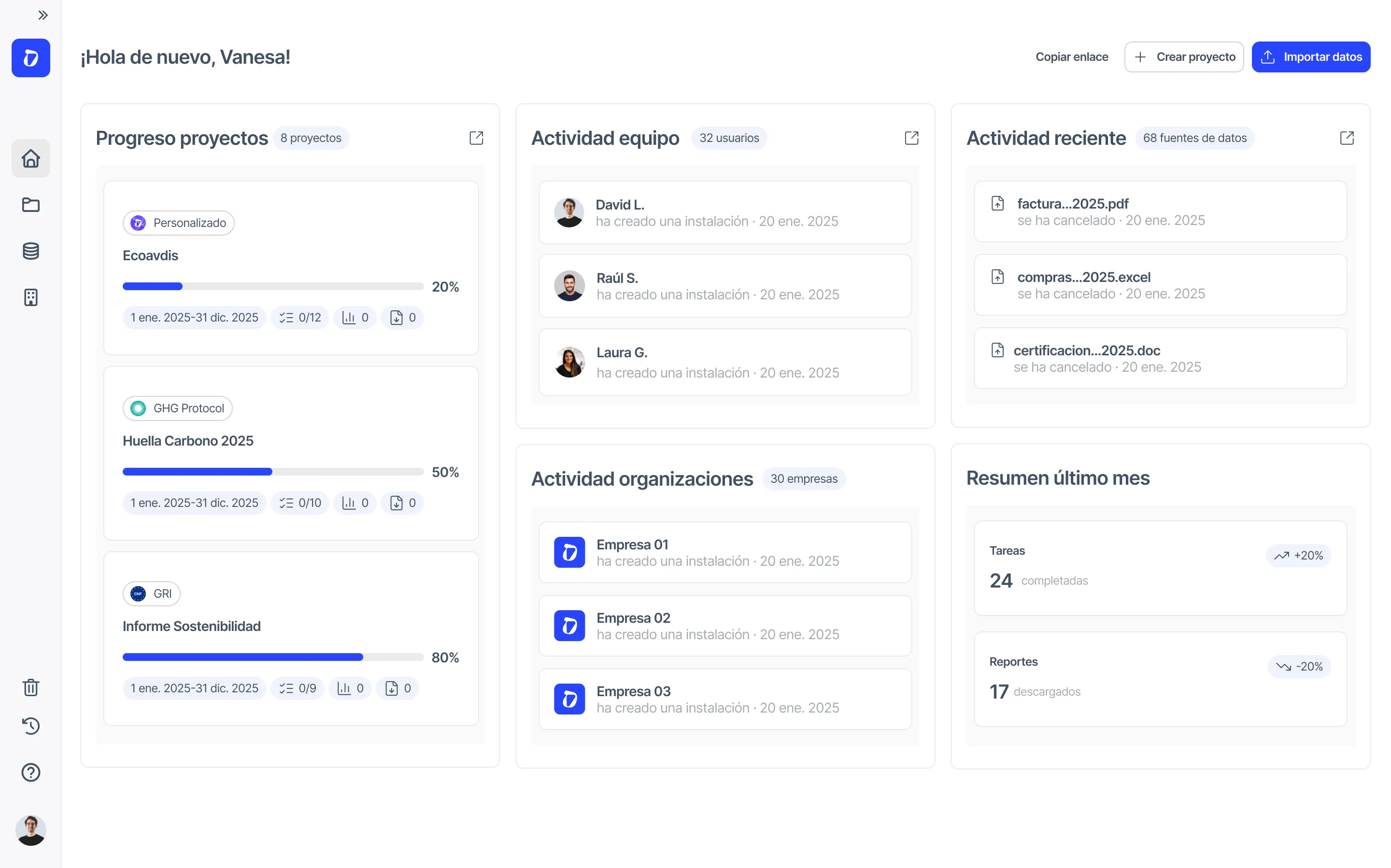
How to create a decarbonization plan step by step
Four stages: measure scope 1, 2 and 3 emissions; diagnose the highest-impact sources; plan annual targets aligned with SBTi; execute measures and track progress regularly. Dcycle automates measurement and tracking, maintaining data continuity year over year.
Request a demo
How to calculate scope 3 in a decarbonization plan
Scope 3 covers indirect value chain emissions: purchases, transport, travel, waste and product use. It can represent more than 70% of the total footprint. Dcycle enables collection of primary supplier data, assignment of default factors when unavailable, and breakdown of scope 3 by the 15 GHG Protocol categories.
Request a demoWhat Dcycle covers in your decarbonization plan
Scope 1, 2 and 3 calculation
Methodology aligned with the GHG Protocol. Up-to-date emission factors and full traceability by source, category and period.
Supplier engagement
Collect primary emissions data from your suppliers directly in Dcycle. Reduce reliance on estimates for scope 3.
Reduction targets and tracking
Define targets by scope and year. Visualize progress in real time and detect deviations before year-end.
SBTi-aligned targets
Set science-based reduction targets following the SBTi methodology. Dcycle calculates the effort needed per scope to meet your 1.5°C trajectory.
What a corporate decarbonization plan includes
GHG emissions inventory
The foundation of any plan is a verifiable inventory of greenhouse gas emissions covering scopes 1, 2 and 3, organized by category, source and reporting period.
Science-based reduction targets
Targets must be specific, measurable and aligned with climate science (SBTi) or applicable regulatory thresholds. A target like "30% reduction by 2030 vs. 2022 baseline" is verifiable and auditable.
Action plan by business area
The plan must specify which measures will be taken in each area: energy efficiency, renewables, logistics, sustainable procurement, waste management and value chain emissions reduction.
Annual tracking and reporting mechanism
Without tracking, the plan fails. Dcycle automatically generates the annual emissions report with comparison against the baseline year and reduction target, ready for external verification.
More than 70% of a company's emissions are typically in scope 3. Discover how Dcycle helps you calculate and reduce them with real data from your suppliers.
Example decarbonization plan for companies
A distribution company with 500 employees discovered with Dcycle that 78% of its emissions were in scope 3, concentrated in raw material purchases and last-mile logistics.
Vehicle fleet and HVAC systems
Measure applied: renewal of 40% of the fleet to electric vehicles and migration to a heat-pump climate system. Estimated reduction: 320 tCO2e/year.
Office and warehouse electricity
Measure applied: 100% renewable electricity contract certified with guarantees of origin. Reduction: 180 tCO2e/year at near-zero marginal cost.
Supply chain and logistics
Measure applied: engagement with the top 15 suppliers to obtain primary emissions data and sustainable procurement criteria. Projected reduction: 1,200 tCO2e over 3 years.
Standards and frameworks guiding corporate decarbonization
A solid decarbonization plan is built on internationally recognized methodologies. These are the frameworks Dcycle works with.
GHG Protocol: the foundation of the emissions inventory
The GHG Protocol Corporate Standard is the global reference framework for calculating and reporting emissions. It defines the three scopes, inventory boundaries and methodology by category. Dcycle applies its emission factors and calculation structure natively.
SBTi: science-based reduction targets
The Science Based Targets initiative sets the criteria for reduction targets aligned with the 1.5°C pathway. SBTi targets are the reference standard for companies seeking credible, verifiable commitments. Dcycle calculates the reduction effort needed per scope to meet the validated trajectory.
Net Zero: long-term commitments
The SBTi Net-Zero standard defines requirements for a company to reach net-zero emissions: deep reductions across the entire value chain and only then neutralization of the residual with permanent removals. Dcycle helps structure the roadmap to Net Zero with real data.
Scope 3: the core of the decarbonization plan
The GHG Protocol requires including scope 3 when material. For most sectors it represents more than 70% of the total footprint. Ignoring it means an incomplete plan that does not reflect the company's true climate reality. Dcycle facilitates scope 3 calculation with primary supplier data and all 15 protocol categories.
Benefits of implementing a corporate decarbonization plan
Sustainability managers at mid-sized and large companies
If you manage your company's carbon footprint and need a systematic process to measure, plan and report emission reductions, Dcycle is your tool. No spreadsheets, no year-on-year inconsistencies.
Companies with climate commitments or SBTi targets
If your company has made science-based reduction commitments (SBTi, Net Zero, carbon neutral), you need a system that tracks real progress and generates verifiable evidence year after year.
Companies under pressure from clients or investors to decarbonize
More and more corporate clients and investment funds demand that their suppliers and portfolio companies have a decarbonization plan with verifiable targets. Dcycle helps you build it and communicate it with real data.
How to create your decarbonization plan with Dcycle
Connect your data sources
Integrate your ERP, utility invoices, fleet data and purchase records. Dcycle automatically classifies each data point by scope and GHG Protocol category.
Calculate your carbon footprint
Get a complete scope 1, 2 and 3 emissions inventory with up-to-date emission factors. Identify the highest-impact sources in seconds.
Define targets and action plan
Set annual reduction targets by scope. Dcycle helps you calculate the effort needed to meet your SBTi trajectory or your company's climate commitments.
Execute, measure and report
Record the measures implemented, measure their impact on emissions and generate the annual report with documentary evidence ready for audit.
Common mistakes when building a corporate decarbonization plan
Not calculating scope 3 correctly
The most common mistake is calculating only scopes 1 and 2 and ignoring scope 3 due to its complexity. The result: an inventory covering less than 30% of the real footprint. No verifier accepts it and it is not valid for CSRD.
Using estimated instead of real data
Estimating energy consumption or purchases instead of using invoiced data produces inventories with high uncertainty. When an audit arrives, the data cannot be verified and the entire inventory is called into question.
Not tracking the plan
A decarbonization plan measured only once a year without quarterly tracking does not detect deviations in time. Reduction measures may have been implemented without a real impact on emissions, and the company does not know until year-end.
A decarbonization expert with you from day one
A Dcycle specialist guides you through inventory setup, scope 3 calculation methodology and definition of reduction targets. No external consultants, no months of prior analysis.
Request a demo Dcycle sustainability experts team
FAQ about corporate decarbonization plans
What is a corporate decarbonization plan?
A corporate decarbonization plan is the roadmap through which a company defines how it will reduce its greenhouse gas emissions over time. It includes carbon footprint measurement (scopes 1, 2 and 3 per the GHG Protocol), identification of priority emission sources, setting verifiable reduction targets and an action plan with concrete measures by business area. It must be updated annually with real data and aligned with the GHG Protocol and science-based frameworks such as SBTi or Net Zero.
How to create a decarbonization plan step by step?
The process has four stages: 1) Measure scope 1, 2 and 3 emissions with a verifiable inventory. 2) Identify the main emission sources and their reduction potential. 3) Define annual reduction targets with a scientific basis, aligned with SBTi or the company's climate commitments. 4) Execute concrete measures and track progress regularly with real data. Dcycle automates the measurement and tracking stages.
Is a decarbonization plan mandatory for companies?
There is no universal legal obligation to have a decarbonization plan, but there is growing pressure from three fronts: ESG investors that require it as a financing condition, corporate clients that demand it from their suppliers as part of their own value chain commitments, and voluntary frameworks like SBTi that require a verifiable reduction plan to validate targets. For many companies, a decarbonization plan is already a market requirement, even if it is not strictly a legal obligation.
How to calculate scope 3 in a decarbonization plan?
Scope 3 covers indirect value chain emissions: purchases of raw materials, transport, business travel, product use by the customer and end-of-life disposal, among other categories. Calculating it requires primary data from suppliers or secondary emission factors (databases like Ecoinvent). Dcycle enables direct collection of primary data from suppliers, assignment of default factors when data is unavailable and breakdown of scope 3 by the 15 GHG Protocol categories, with full data traceability.
What data does a company need to decarbonize?
For scope 1 you need data on fuel consumption (diesel, natural gas, LPG) and refrigerant gases. For scope 2, electricity invoices and, where applicable, heat or steam consumption data. For scope 3 you need purchase data, transport records, business travel data, waste generation information and data on product use and disposal. Dcycle centralizes the collection of all this data and classifies it automatically.
How long does it take to implement a decarbonization plan?
The first carbon footprint measurement (baseline inventory) can be completed in a few weeks with Dcycle, depending on the availability of internal data. Defining the decarbonization plan with targets and concrete measures typically takes one to two additional months. Many companies complete their first full inventory (including scope 3) before the end of the first quarter after contracting Dcycle.
What frameworks and standards guide corporate decarbonization?
The two main reference frameworks are the GHG Protocol, which defines the methodology for calculating scope 1, 2 and 3 emissions, and SBTi (Science Based Targets initiative), which sets the criteria for reduction targets aligned with climate science. For companies seeking Net Zero commitments, the SBTi Net-Zero standard defines long-term reduction requirements. Dcycle is aligned with both frameworks.
What are the benefits of a corporate decarbonization plan?
The benefits are primarily commercial and strategic. Commercially, it opens access to tenders with companies that require supplier emissions data, improves the profile with ESG investors and allows public commitments to be validated with real evidence. Operationally, the decarbonization process typically identifies energy inefficiencies and cost-saving opportunities. Strategically, it reduces exposure to climate risk as carbon pricing and market pressure increase.
What is the best tool for building a decarbonization plan?
The best tool automates emissions calculation (including scope 3), enables supplier engagement to collect primary data, provides real-time SBTi target tracking and generates verifiable reports year after year. Dcycle covers all these requirements in a single platform, with up-to-date emission factors, full traceability and support from sustainability experts. Unlike spreadsheets or one-off consulting solutions, Dcycle scales with the company and maintains data continuity year over year.
Start your decarbonization plan today
Measure your carbon footprint, calculate scope 3 with real data and build a reduction plan that holds up to audit. Dcycle makes it systematic.